
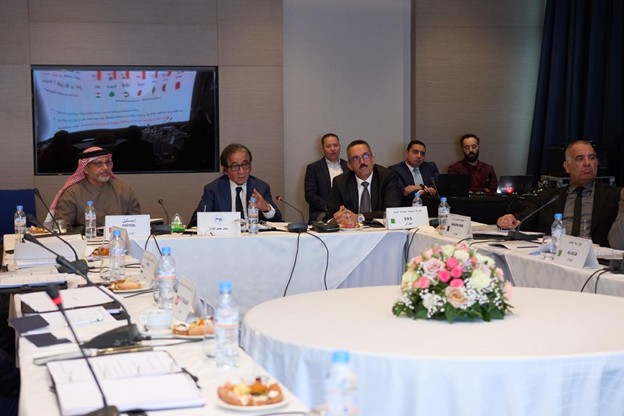
The Board of Directors of the Arab Steel Union, headed by Engineer Ahmed Ezz, decided in its regular session in the Algiers capital on January 26, 2026, to establish a new department for economic studies and market research, aiming to enhance the Union’s capabilities and support its members in making informed decisions, by providing a reliable information and analytical base that supports decision-making processes within the Union, thus contributing to increasing the competitiveness of the Arab iron and steel sector in the local, regional and international markets.
The administration issues a weekly high-level scientific report on the topics: billet, rebar, and flat steel, and in parallel with it a weekly report on trade measures, protectionist policies, and all issues related to dumping, taxes, and fees.
The administration also seeks to create a comprehensive database on the Arab steel industry with regard to the four main products: rebar, flat steel, billet, and liquid steel, according to several criteria, the most prominent of which are: the production capacity of each country with its classification according to the level of technology used, then actual production, then exports, then imports, and finally apparent consumption.
Creating an index for Arab steel prices in the most important producing and exporting countries is a priority for the Market Research Department’s work, as the index includes countries such as the United States, the European Union, China, Turkey, and Russia. This indicator supports the preparation of short-term forecasts for Arab steel markets regarding demand and production, in addition to issuing reports on target markets for export, and continuous periodic updating of digital data available on the Union’s platforms.
In addition, the Department of Economic Studies and Market Research issues regular quarterly reports on production, demand and trade trends in Arab countries, which help in evaluating the effects of protectionist policies such as fees and protection measures, and contribute to creating a mechanism for controlling carbon borders (CBAM) in European Union countries, as well as preparing benchmarking reports.