
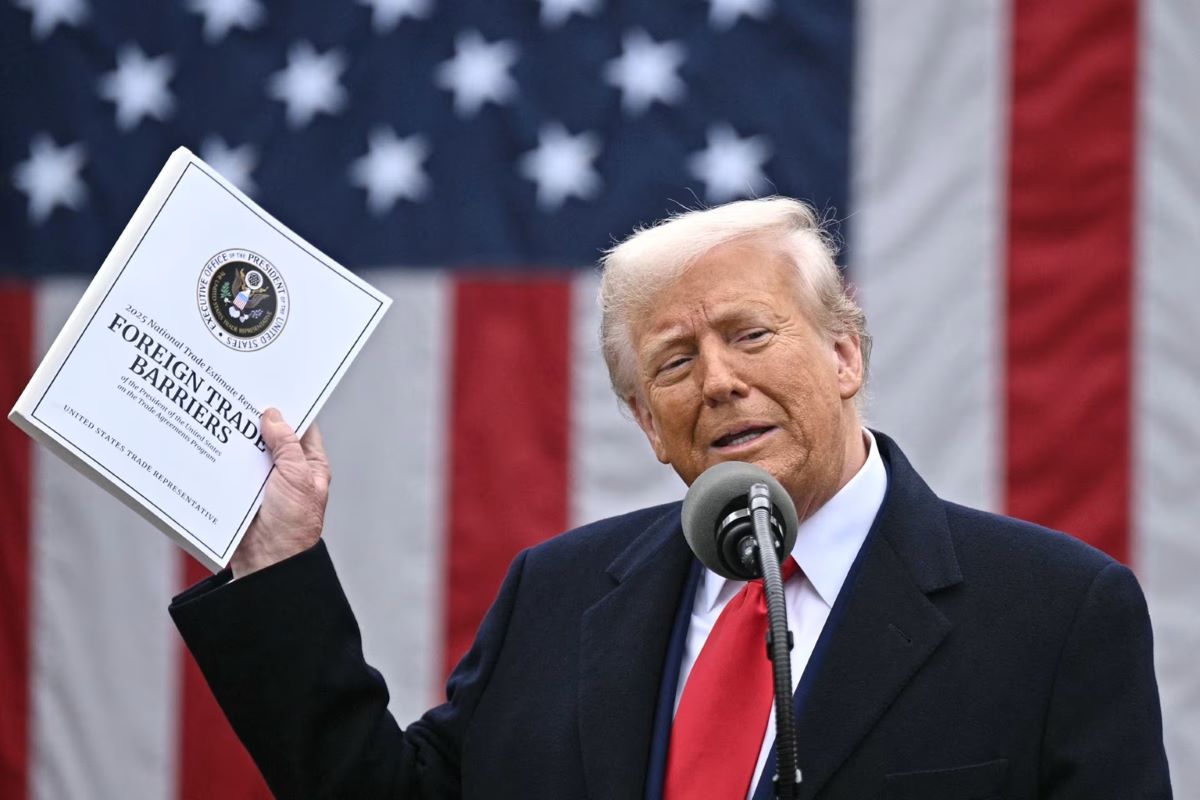
Leaders from countries affected by US President Donald Trump's announcement of tariffs on US trading partners responded in a speech at the White House on Wednesday, marking what he described as "Liberation Day."
Italian Prime Minister Giorgia Meloni
said on Facebook: "The US imposing tariffs on the European Union is a move I consider wrong and inappropriate for either party." She added: "We will do our utmost to reach an agreement with the United States, with the aim of avoiding a trade war that would inevitably weaken the West to the benefit of other global players. In any case, and as always, we will act in the interests of Italy and its economy by discussing the matter with our other European partners."
Polish Prime Minister Donald Tusk
said on social media: "Friendship means partnership. Partnership means fully reciprocal tariffs, and appropriate decisions are needed."
Irish Prime Minister Micheál Martin
said on social media: "I firmly believe that tariffs do no good to anyone. They are harmful to the global economy, and they hurt people and businesses. That's why I deeply regret the US administration's decision this evening to impose a 20% tariff on all goods imported from the European Union." He added: "My priority, and the government's, is to protect jobs and the Irish economy. We will work with our businesses, multinational companies, and Irish businesses to navigate the next phase, and we will work with our colleagues in the European Union to enter into a negotiating process with the United States to mitigate the damage caused by these tariffs."
Swedish Prime Minister Ulf Kristersson
said on social media, "We do not want increased trade barriers or a trade war. This would only make our people poorer and the world more dangerous in the long run. But Sweden and the Swedish government are well prepared for what is happening now. We stand on solid economic ground, with world-class public finances. In the European Union, I will continue to seize every opportunity to reverse these developments. My hope, and our goal, is to be able to contain the new US tariffs."
Norwegian Minister of Trade and Industry Cecilie Merseth
told NRK, the state broadcaster, "This is clearly serious for the global economy, and it is extremely important for Norway. What we are seeing at first glance is a 20% tariff on the EU and at least 10-15% on Norway. This is extremely important because we also export a lot to the EU, so it will affect us as well. This is an important day, and now we need to understand what this actually means for Norway."
New Zealand Trade Minister Todd McClay
said, "Tariffs in and of themselves are not good for trade. They are likely to impact not only international trade, but also inflation, demand, and some currency rates. However, we will work closely with our exporters throughout the day and with some of our exports to obtain as much information as possible so we can be prepared in this market."
The Chinese Ministry of Commerce
also said that China "firmly opposes these tariffs and will resolutely take countermeasures to protect its rights and interests." The ministry spokesperson added in a statement: "The United States claims losses in international trade and raises tariffs on all its trading partners under the pretext of so-called 'reciprocity.' This practice ignores the balance of interests achieved in multilateral trade negotiations over the years." He continued: "The truth is that the United States has benefited greatly from international trade and imposed so-called reciprocal tariffs based on subjective and unilateral assessments. This is contrary to international trade rules and seriously harms the legitimate rights and interests of the parties involved. It is a typical practice of unilateral bullying." He stated: "History has proven that raising tariffs cannot solve the United States' problems. It not only harms its own interests but also threatens global economic development and supply chain stability. There is no winner in a trade war, and there is no way out of protectionism." China urged the United States to "immediately revoke its unilateral tariff measures and properly resolve disputes with its trading partners through equal dialogue."
Colombian President Gustavo Petro
said, "The US government now believes that raising tariffs on its imports in general will increase its production, wealth, and jobs. In my opinion, this could be a grave mistake." He added, "We will lower tariffs on what allows for more advanced industrial development in Colombia, and raise tariffs on what prevents us from developing advanced or strategic production in the country."
In Brazil, the Ministry of Development, Industry, Trade, and Services
said, "The government regrets the decision taken by the US government to impose an additional 10% tariff on all Brazilian exports to it. This new measure, like other tariffs already imposed on the steel, aluminum, and automotive sectors, constitutes a violation of the United States' obligations under the World Trade Organization and will affect all Brazilian exports of goods to the United States." She added, "While the Brazilian government remains open to deepening the dialogue initiated over the past few weeks with the US government to rescind the announced measures and address their harmful effects as soon as possible, it is evaluating all possible measures to ensure reciprocity in bilateral trade, including recourse to the World Trade Organization, in defense of legitimate national interests." For his part,
Acting South Korean President
Han Deoksoo ordered his government to "do everything possible to overcome the trade crisis." In an emergency meeting, he called on the Ministry of Trade to "carefully analyze the details and impact of the tariffs and actively engage in negotiations with the United States to minimize the damage." He also asked the government to prepare emergency support measures for affected industries and companies. It is worth noting that Trump described "Emancipation Day" as "one of the most important days" in American history, and that it is "a declaration of our economic independence." He emphasized that the United States will use the funds generated by the tariffs "to reduce our taxes and pay off our national debt." He said, "For years, hardworking American citizens have been forced to stand idly by while other countries grow richer and more powerful, much of it at our expense. But now it's our turn to prosper." He claimed that the tariffs would lead to increased manufacturing in the United States, which "will mean stronger competition and lower prices for consumers." Trump emphasized that he puts "America first," saying, "Today we stand up for the American worker." He claimed that the United States takes care of "the countries of the world, and then when you want to lower the tariffs a little bit, they get upset that you don't take care of them." He added that the tariffs are proof that "we will take care of our own people first." He said, "We can really be very rich, and we can be much richer than any country. It's unbelievable, but we're getting smarter."