· Those who possess steel capabilities are most able to withstand global markets
· Ukraine, from an industrial base exceeding 21 million tons to an industry fighting to preserve 7 million tons
· The European Union tracks products by country of origin, and Britain calls for supporting local industry
· 720 thousand tons is Tunisia's consumption of ready-made steel until the end of 2026
· The Mauritanian steel market is growing, driven by energy and infrastructure projects
· Andrew Carnegie, the American steel magnate... from an immigrant boy to the throne of the global steel empire
The Arab Iron and Steel Union's Media Center has issued the seventeenth issue of the Arabic Steel Weekly Bulletin in its Arabic and English versions, offering a broad overview of the iron and steel industry landscape in the Arab region, the Middle East, North Africa, and the world. This week, issues of trade protection and dumping intersect with supply chain disruptions and the green transition race, while new production capacities lead to intensified competition amidst transformations that confirm that those who possess steel capabilities will be most able to withstand global markets.
The fight against dumping and trade protectionism is at the forefront of the global scene, after the European Commission adopted a new implementing regulation aimed at enhancing the transparency and traceability of steel products imported into the European Union from their country of origin. The issue analyzes this European step from a broader analytical perspective, tracking the winners and losers of the new European steel rules, and what these rules might mean for Arab countries gradually entering the test of quotas and protected markets.
In the United Kingdom, the British Steel Association has called on the government to take four key measures in the autumn budget to support the local industry and reduce the country's reliance on imports.
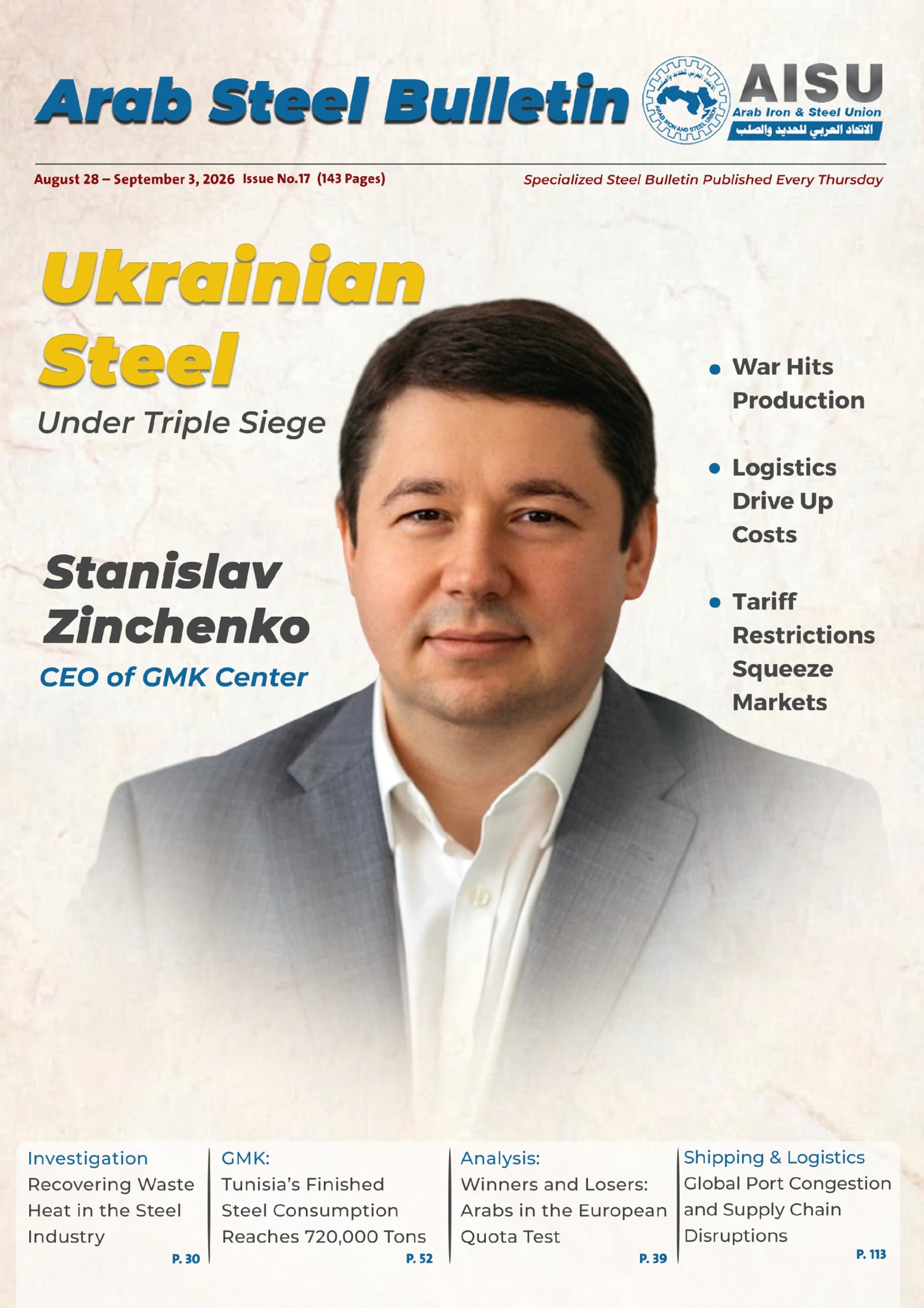
Ukrainian steel fighting for survival is the title of the issue's feature, which tracks the fate of an industry that was once a major industrial base in Europe, before the war undermined its production and logistical infrastructure. From an industrial base exceeding 21 million tons to an industry fighting to preserve about 7 million tons, the Ukrainian steel industry finds itself under simultaneous pressures: military, logistical, and customs, in parallel with the green transition race that is redefining the terms of competition in European markets, as indicated by the issue's editorial.
Within the feature, Stanislav Zinchenko, CEO of the Ukrainian GMK Center, reveals in an exclusive interview with the Arab Iron and Steel Union's Media Center that Europe accounts for about 90% of Ukrainian steel exports, emphasizing that the future steel equation will be increasingly determined by who owns the cheapest energy and the best raw materials.
From the battlefield to the factory floor, the issue's investigation examines waste heat recovery and energy management systems in the steel industry, considering energy efficiency as one of the most direct pathways to reduce both costs and emissions.
In this context, Dr. Maher Aziz, a member of the World Energy Council, calls in statements to the bulletin for the establishment of a fund to support concessional financing, with interest rates ranging between 3% and 5%, for energy efficiency projects in the industry.
Regionally, the bulletin monitors a range of divergent market trends. A GMK report predicts that Tunisia's consumption of ready-made steel will remain around 720,000 tons until the end of 2026, while Oman's Al-Jazeera Steel Products Company has completed the procedures for establishing two wholly-owned subsidiaries in the United States. In Morocco, Sonasid achieved revenues of 3.05 billion dirhams in the first half of 2026, while the Mauritanian steel market is heading towards new growth opportunities driven by energy, gas, and infrastructure projects.
On the global stage, the bulletin notes a 1.6% decline in US crude steel production by the end of August, and a 16% decrease in stainless steel exports over seven months, coinciding with ArcelorMittal's announcement of a $925 million investment in a cold rolling mill in Brazil. In the United States, the South Korean Minister of Industry laid the foundation stone for the joint Hyundai and Posco steel plant in Louisiana, a move reflecting the continued flow of Asian investments into the US market.
The issue reviewed the journey of Andrew Carnegie, one of the most prominent figures in the American steel industry, who went from being a bobbin boy in cotton mills to building a vast industrial empire, before dedicating about 90% of his wealth to philanthropy, culture, and projects that left a lasting impact on American society and the world.
The industry does not move away from the sea when it shifts from the factory to the market. Therefore, the bulletin monitors the congestion of global ports and shipping traffic, with increasing indicators of container ship waiting times and disruptions in unloading and container delivery schedules, due to multiple factors involving trade flow, supply chains, energy, and maritime routes.
In the energy sector, the name of Chinese oil giant PetroChina stands out, which recorded profits of 103.9 billion yuan in six months, an increase of 22%, while its revenues exceeded 1.5 trillion yuan.