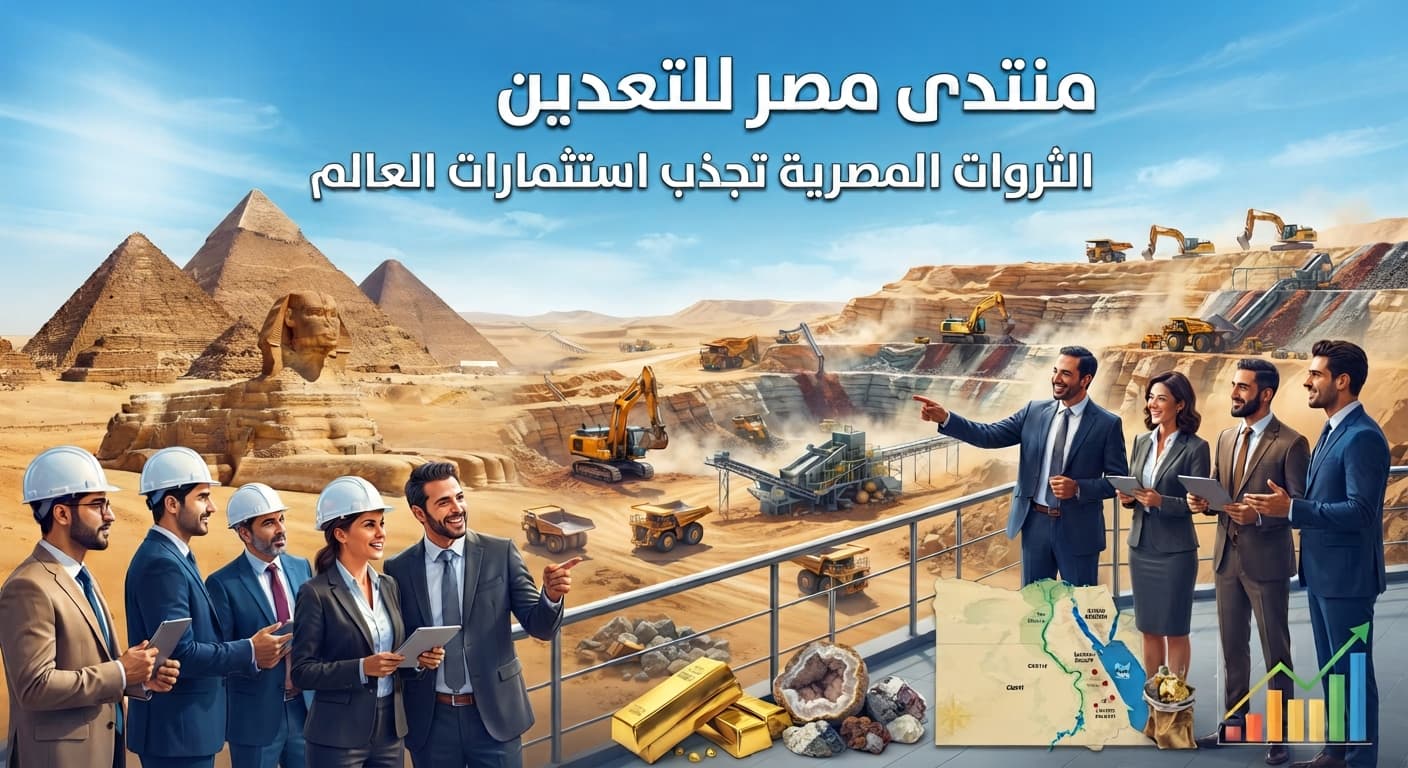
Egypt hosted the fifth edition of the Egypt Mining Forum 2026, under the theme "Unlocking the Exploration Potential of Egypt and the Nubian Shield," with broad participation from governments, international companies, investors, financial institutions, and experts.
The conference sessions, held over two days on September 28 and 29, 2026, witnessed the participation of over 6,000 individuals from more than 50 countries, alongside over 500 conference attendees, more than 100 speakers, exhibiting companies, and approximately 30 strategic and technical sessions addressing investment, exploration, legislation, finance, technology, and manufacturing.
El-Sisi: Committed to the Success of Investments
Egyptian President Abdel Fattah El-Sisi inaugurated the forum's activities. He was received upon his arrival at the venue by Dr. Mostafa Madbouly, Prime Minister, and Eng. Karim Badawi, Minister of Petroleum and Mineral Resources.
The official spokesperson for the Presidency of the Republic stated that a commemorative photo was taken of the President and the forum participants, including representatives of governments, heads of international organizations, and major foreign companies operating in the mining sector. He then toured a section of the exhibits presented by the Geological Museum before the opening sessions commenced.
Ambassador Mohamed El-Shennawy, the official spokesperson, added that the opening program included a film titled "Egypt: From the Gold of the Past to the Future of Mining." This was followed by a speech by Eng. Karim Badawi, Minister of Petroleum and Mineral Resources, and then a speech by Alberto Calderon, CEO of AngloGold Ashanti.
A documentary film about the Sukari mine was also screened. The program also included speeches by Doug Horak, CEO of the Australia-Africa Minerals and Energy Group, and Rohitash Dhawan, President and CEO of the International Council on Mining and Metals. This was followed by a film titled (Open Blocks), then a speech by Namrata Thapar, Global Director of Metals and Commodities at the World Bank Group, which was followed by a live broadcast from several different mining sites in the Arab Republic of Egypt.
In his address during the opening of the Egypt Mining Forum, President El-Sisi welcomed the attendees to the fifth edition of the forum, affirming the Egyptian state's commitment to ensuring the success of investments by companies and businessmen, whether in mining or any other field.
On the sidelines of the forum, President El-Sisi held a meeting with Alberto Calderon, CEO of AngloGold Ashanti, the operator of the Sukari mine, in the presence of the Prime Minister and the Minister of Petroleum.
The spokesperson for the Presidency of the Republic, Ambassador Mohamed El-Shennawy, stated that President El-Sisi expressed his appreciation for the strategic partnership with AngloGold Ashanti, the operator of the Sukari gold mine, and emphasized the state's support for the company's investments in Egypt and its commitment to creating a favorable environment for the growth of its operations.
The President expressed Egypt's desire to elevate the existing cooperation with AngloGold Ashanti from a partnership focused on operating the Sukari mine to a broader strategic partnership in the Egyptian mining sector. This partnership includes exploration, technology and expertise transfer, training national cadres, developing local supply chains, and attracting further investments. The meeting also reviewed the company's operational progress and its future plans for expansion in the Egyptian market, as well as discussing ways to enhance joint cooperation in the mining sector.
For his part, Calderon expressed his appreciation for the meeting with the President, commending the continuous support provided by the Egyptian state to the company, as well as the efforts made by the relevant authorities to overcome any obstacles facing its operations in Egypt. He also reviewed the progress of the company's major investments in Egypt and other countries where it operates globally, affirming that Egypt is a priority investment destination for AngloGold Ashanti.
He indicated that the company plans to inject further investments in the coming period into a number of promising sites within the Egyptian mining sector, thereby enhancing opportunities for discovering and developing new projects similar to the Sukari mine.
The meeting also focused on the prospects for expanding exploration programs undertaken by AngloGold Ashanti in Egypt, particularly in the gold mining sector. President El-Sisi affirmed the state's commitment to providing all necessary facilities to support the company's activities and streamline its operations, as part of Egypt's strategy to expand the mining sector, maximize its contribution to the national economy, and leverage promising investment opportunities in this sector to attract more foreign investments.
Karim Badawi: Mining Targets 6% of GDP
During the opening session, Eng. Karim Badawi, Minister of Petroleum and Mineral Resources, presented the government's vision for developing the mining sector, emphasizing that Egypt possesses the necessary components to build an integrated mining sector capable of increasing its contribution to the economy.
He explained that the state aims to increase the mining sector's contribution to the gross domestic product to approximately 6% in the coming phase, compared to less than 1% currently. This will be parallel to increasing investments and companies operating in the sector, expanding manufacturing projects, and maximizing added value. He clarified that this percentage reveals the scale of the targeted transformation; the requirement is no longer just to increase the production of gold, phosphates, or mineral ores, but to build an economic chain starting from surveying and exploration, through extraction and processing, to downstream industries and export.
Badawi revealed significant results from the open-area mining sector bid system, launched on June 10, 2026. Within the first three months, 119 companies applied, including more than 14 foreign companies from Australia, the United Kingdom, Canada, Saudi Arabia, Turkey, South Africa, India, and China.
Badawi noted that the companies submitted 403 bids for 118 sectors out of a total of 335 offered sectors, covering an area of approximately 45,000 square kilometers. These areas are promising for the search for gold, phosphates, talc, kaolin, and other ores. He stressed that the level of interest reflects a significant shift in investor appetite towards the Egyptian market, especially with the simplification of bid mechanisms and the availability of a more flexible model for awarding mining areas.
Badawi affirmed that the ultimate goal is not limited to increasing production but also includes creating job opportunities, boosting exports, attracting investments based on technology and knowledge, and linking mining to industry. He pointed out that Egypt possesses the third-largest global reserves of phosphate ore and ranked seventh globally in phosphate production in 2025.
Badawi revealed that work is underway on 8 projects aimed at maximizing the added value from phosphate ore, as part of the strategy to expand downstream industries instead of merely extracting and exporting raw materials. He noted that the foremost among these projects is the implementation of the first phase of the phosphoric acid complex in Abu Tartur, with investments totaling $650 million. He explained that the first phase of the complex aims to achieve a production capacity of 250,000 tons of phosphoric acid annually, with production targeted to commence in 2028.
and pointed out that the projects fall within the Ministry of Petroleum and Mineral Resources' direction to increase the economic return from mineral ores by linking resource extraction with processing and manufacturing operations, emphasizing that the mining sector development strategy aims to transition from extracting and exporting raw ore in its primary form to expanding in downstream industries, thereby increasing added value and attracting new investments to the sector.
Badawy indicated that Egypt holds a leading global position in phosphate reserves and production, while the state is working to leverage these resources to establish industries and products with higher economic value.
Legislative Reforms
The Minister of Petroleum reviewed the institutional and legislative reforms aimed at improving the investment environment, most notably Law No. 87 of 2025 regarding the reorganization of the Mineral Resources Authority and its transformation into the Authority for Mineral Resources and Mining Industries as an economic authority. He noted the development of a new model for gold exploration agreements, providing greater clarity and flexibility, in addition to amendments to the executive regulations to support exploration and prospecting activities and offer incentives to investors.
Badawy stressed that the state also seeks to develop the geological database by conducting targeted aerial surveys, which will provide more accurate information about mineral wealth and reduce the risks and costs of exploration operations.
The Sukari mine occupied a pivotal position in the forum's activities as the most prominent example of Egypt's ability to host global mining projects. Badawy explained that the Sukari mine, one of the largest gold mines globally, embodies the promising wealth Egypt possesses. Its total production reached 6.8 million ounces since production began in June 2009, confirming the potential for greater results in the coming phase.
Khaled Hashem: Serious Steps to Advance Mining Industries
Engineer Khaled Hashem, Minister of Industry, participated in the panel discussion held on the sidelines of the fifth edition of the Egypt Mining Forum, titled "Aligning Mineral Resource Development with Industrial Growth." The session included Engineer Salah Zouari, Minister of Equipment, Housing, and Acting Minister of Industry, Mines, and Energy of Tunisia; Jethro Chimbo, Head of the Subcommittee for Foreign Affairs at the Congolese Ministry of Foreign Affairs. The session was moderated by journalist Aithne Trenor, in the presence of Engineer Mohamed Zada, Assistant Minister of Industry for Strategic Industries, and Engineer Mohamed Sami, Assistant Minister for Strategic Affairs.
During the session, Engineer Khaled Hashem, Minister of Industry, affirmed that Egypt has taken serious steps in recent years to advance mining and mining industries, especially with the launch of the Egyptian Industry Strategy, which identified basic minerals as strategic industries. He noted that a study is currently underway for all minerals currently extracted in Egypt to determine their manufacturability and improve mineral processing value chains to increase the added value of Egyptian minerals and transform them into raw materials serving the industry sector.
The Minister stated that the government aims to develop integrated value chains for the mining sector, linking extraction, processing, refining, and manufacturing based on minerals. This will be achieved by aligning mining and industrial policies, contributing to the utilization of mineral resources to support higher added-value industries, strengthening local and regional supply chains, reducing reliance on imported inputs, and creating new export opportunities. He noted the government's approach to treating mineral resources not as commodities but as raw materials for integrated industries, aiming to link Egyptian industry with regional and global value chains.
Hashem explained that Egypt has taken steps to limit the export of raw phosphate, prioritizing local manufacturing and downstream industries with higher added value, such as the production of phosphoric acid and phosphate fertilizers, instead of exporting raw phosphate.
The Minister explained that Egyptian manganese ore is one of the ores that represents a key input in the iron and steel industry and heavy industries, and is an important tool for maximizing the benefit from mineral wealth. It is a significant contributor to reducing the import bill for refractories, silicon, and manganese alloys. He noted that cooperation with two companies this year has focused on locally manufacturing the ore to provide it at high concentrations, increase exports, create new jobs, and deepen local supply chains.
Regarding cooperation with African countries, Hashem affirmed that intra-African trade volume is approximately $220 billion, a modest figure considering the 54 African countries, the continent's capabilities and resources, its high demand, and its import volume from the world. He highlighted the necessity of integration among African countries in the mining sector, where each country contributes what it can in terms of workforce training, expertise, skills, technology, mineral ores, and manufacturing capabilities to produce mineral-based products serving all African countries. This is the objective that the 'Africa El Alamein' forum, which Egypt will host next month, will emphasize.
International Acclaim
Several leaders from major international mining companies and institutions praised Egypt's mining sector reforms, which aim to improve the investment climate, enhance exploration and production activities, and increase the added value of mineral resources, as presented during the forum.
Alberto Calderon, CEO of AngloGold Ashanti, the fourth-largest gold mining company globally, praised President Abdel Fattah El-Sisi's vision for modernizing the Egyptian economy and elevating the mining sector. He commended the efforts made by the Ministry of Petroleum and Mineral Resources over the past two years to translate this vision into practical steps and create an attractive environment for long-term mining investments.
Calderon affirmed that the Ministry recognized the structural, financial, and legal requirements needed by mining investors before committing long-term capital and moved to develop them. He pointed out that updating the mining law, developing financial terms, simplifying licensing procedures, and establishing an independent economic authority have contributed to providing a more transparent and efficient business environment, sending a clear message to international capital markets about Egypt's openness to long-term investments in the mining sector.
He explained that AngloGold Ashanti's decision to enter the Egyptian market in November 2024 by acquiring Centamin, the owner of the Sukari mine, was based on the mine's global standing and the promising potential for further discoveries in Egypt. He noted that the company, which had not made significant acquisitions for nearly 20 years, subjected its decision to enter Egypt to a thorough evaluation based on four key pillars: promising geological potential, human capital, infrastructure, and government support.
Calderon pointed out that the Sukari mine represents practical evidence of the geological potential and wealth that Egypt possesses, explaining that the accumulated experience in major gold-producing regions in Australia, Canada, and West Africa indicates that the presence of a large deposit can be an indicator of opportunities to discover other deposits in surrounding areas.
He affirmed that exploration activities using modern technologies in the Eastern Desert are still limited, which opens the door to broad opportunities for Egypt, the global gold sector, and the company, which possesses the technical expertise, capital, and capabilities necessary to develop and operate large mines in accordance with international standards.
Calderon revealed that AngloGold Ashanti recently submitted applications to invest in 19 new gold exploration areas in the Eastern Desert, covering an area of over 3,000 square kilometers, driven by the reforms witnessed by the mining sector and the company's confidence in Egypt's geological potential.
He added that the company has allocated a budget of millions of dollars for exploration activities in virgin areas during 2027, aiming to achieve new discoveries, noting its aspiration to employ its specialized teams and technologies for mapping using satellites, airborne geophysical surveys, and drilling technology, in exploring the next generation of gold deposits in Egypt.
Regarding the Sukari mine, Calderon explained that it represents the cornerstone of the company's presence in Egypt, operating within a profit-sharing partnership with the Egyptian state through the Egyptian Mineral Resources Authority and Mining Industries, noting that the mine has produced more than 6.8 million ounces of gold since production began in 2009.
He added that Sukari's production during 2025 reached about 500,000 ounces, which he described as world-class performance, contributing to record revenues for Egypt exceeding $590 million in one year.
He affirmed that the company, in cooperation with its partners in the Egyptian government, is injecting significant investments into Sukari's future, through implementing a new drilling campaign aimed at extending the mine's life and increasing production, noting that technical competencies and skilled labor represent one of Egypt's most prominent competitive advantages, explaining that Egyptians constitute 97% of the total workforce at the Sukari mine, and also explained that Egypt's infrastructure significantly contributes to reducing the cost of transitioning from the exploration to production phase, compared to new mining markets in the region.
Egyptian-Australian Cooperation
For his part, Doug Horak, CEO of the Australia-Africa Minerals and Energy Group (AAMEG), which includes about 100 Australian companies, representing the Australian mining community, affirmed that Egypt is going through an important phase aimed at supporting growth and developing the mining sector, expressing his appreciation for the growing cooperation between Egypt and Australia in this field.
He indicated that over the past twelve months, he has held contacts with the Ministry of Petroleum and Mineral Resources and mining officials in Egypt to explore cooperation and investment opportunities, emphasizing that openness, willingness to cooperate, and building partnerships are essential elements in the current phase.
He pointed to the increasing global competition for mining investments and resources, stressing that Egypt has an important opportunity to enhance its presence on the global mining map, benefiting from its geological potential, strategic location, and reforms aimed at improving the investment environment and supporting exploration activities.
Horak affirmed that the next phase of Egyptian-Australian cooperation should focus on transforming plans into executive steps, and providing greater opportunities for startups and medium-sized companies to participate in exploration activities, especially gold exploration in Egypt.
The International Council on Mining
Rohitesh Dhawan, CEO of the International Council on Mining and Metals (ICMM), affirmed that Egypt has a clear opportunity to develop a mining sector more capable of attracting investments, noting that the Egyptian sector is undergoing a significant transformation that enhances its attractiveness to investors, explaining that the reforms implemented by the Egyptian government represent an important step to advance the mining sector, emphasizing the importance of continuing to work on an integrated package of reforms that includes strengthening geological knowledge and capabilities, developing infrastructure, improving market access, and enhancing cooperation with local communities, noting that the success of the mining sector requires strong technical capabilities, effective cost management, and distinguished human competencies, in addition to a shared vision and continuous interest in developing the sector.
Dhawan affirmed that Egypt already possesses many of these components, with its promising geological potential and strong human resources base, in addition to advanced infrastructure including energy supplies and transportation networks, as well as a distinguished geographical location that allows access to global markets via the Red Sea, noting that the integration of mining, processing, and industrial services capabilities can provide Egypt with an integrated system for developing new projects and creating additional markets and investment opportunities, thereby strengthening its position on the global mining map.
The World Bank
For her part, Namrata Thapar, Global Director for the Mining and Metals Sector at the World Bank Group, affirmed that the Egypt Mining Forum represents an important platform for dialogue and cooperation on the future of the mining sector, noting that Egypt is moving forward in implementing its development goals, and that the results of the reform agenda that has been implemented provide a basis for further cooperation and investment.
She explained that Egypt can provide an important model in transforming vision and reforms into practical actions, which contributes to attracting more investments and expanding the base of economic activities related to mining, emphasizing that Egypt possesses a number of components that can support the competitiveness of the mining sector, including competitive costs, strong infrastructure, and opportunities for responsible private investment across various stages of the value chain.
She pointed out that the mining sector can represent an important driver of economic growth in light of the potential and opportunities that Egypt possesses, emphasizing the importance of continued joint work to achieve a broader economic and developmental impact at the level of the economy and communities.